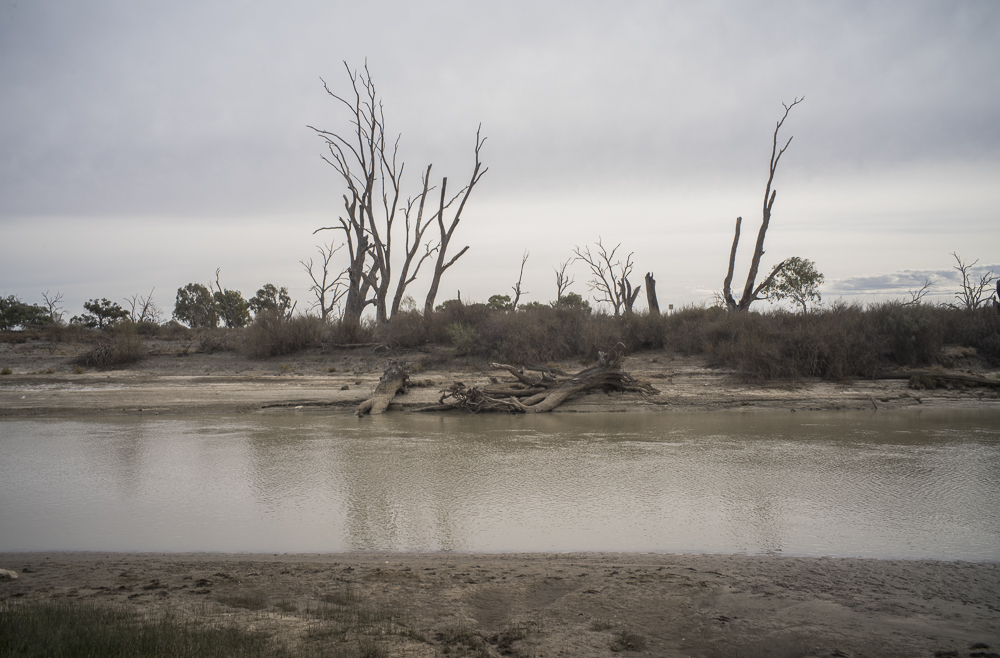
I am planning to go on a photocamp at Wentworth in NSW next week for the Mallee Routes project. I leave after Anzac Day, on Friday 26th of April. Whilst there I plan to explore along the lower Darling River, which is in dire straits due to the massive increased water use upstream, bad water management and corruption. The result is that the Darling is no longer a healthy river system.
During this photocamp I also plan to scope and to start to make some photos for the Our River Our Country project. I have yet to make any photos for the latter project, as it is still in the embryonic stage of designing the project, inviting other photographers to participate, and taking advice from gallery directors and curators about how best to respond to the Godson Collection. There is still a lot of preliminary work to do before we start applying for grants for a curator and various residencies.
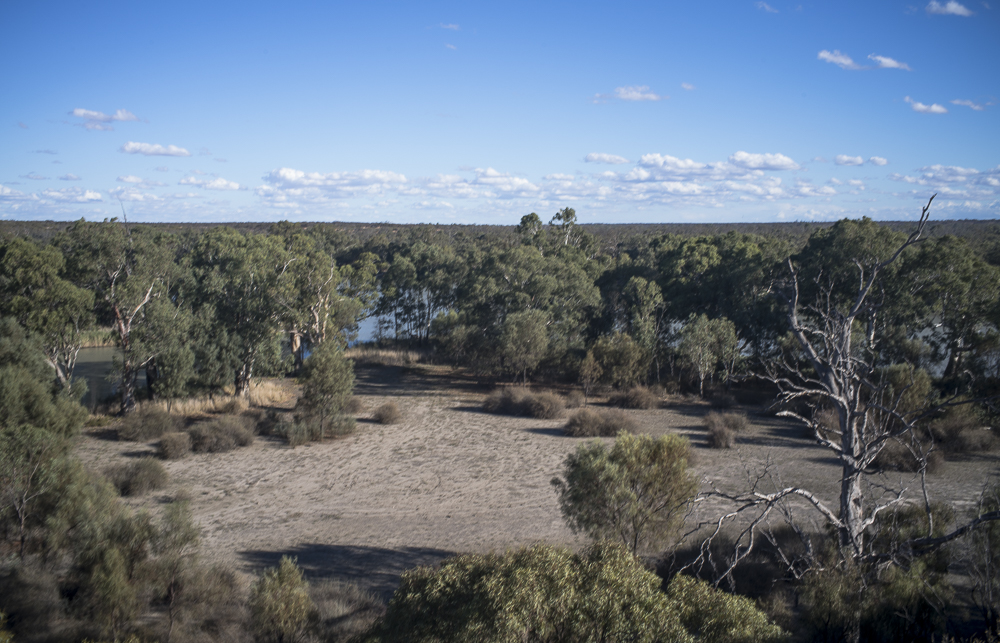
The photo above was made near the Nor’west Bend at Morgan on the western side of the River Murray. The Nor’west Bend is where, in October 1839, the overlanders, who were driving their cattle and sheep on the Overland Stock Route between Sydney and Adelaide killed 11 Aboriginal people in retaliation to the local indigenous (the Ngayawung) people) attacking the overlander’s party and stock and killing the overseer (Thomas Young). This is one of the early massacres of aboriginal people in South Australia. The overland stock route was a site of frontier conflict and aboriginal resistance. The South Australian colony was almost bankrupt and any threat to the overland route threatened the financial viability of the Colony.
Whilst at the Mallee Routes Wentworth photocamp I plan to start to photograph the landscape along the colonial Overland Stock Route with an 8×10 camera and black and white film. I will initially concentrate on the landscape of the 1841 massacre site at Rufus River near Lake Victoria. The Rufus River connects Lake Victoria and the Murray River and the massacre of the Barkindji people took place in August 1841 where the Overlander’s trail crossed the Rufus between Lake Victoria and the River Murray at a site known as ‘Langhorne Ferry’. This happened when George Grey was Governor of South Australia, and an official enquiry into the “Rufus River Massacre” found no fault with the actions of the expedition whose task was the suppression of the “outrages” upon the part of overland parties such as attacking European stock and overlanders.

The Overland Stock Route was established in 1838, and it followed a much older Aboriginal pathway. It bought enormous quantities of men, arms, goods and stock within what was a highly territorialised Aboriginal landscape. This crystallised the tone of the later hostile encounters. As the layers of encounter built up along the route, attitudes towards Aboriginal people hardened and violence become ever more acutely anticipated and accepted.
The massacres along the Overland Stock Route have been historically been framed by the colonial/imperial narrative as representing a triumph of civilisation over savagery. Thee massacres are presented as manly, civilised, nation-building activities. The identification of ‘the Aborigine’ was historically constructed in European thought and imagination as the primitive native and understood in terms of distance from the ‘civilised’ European male who stood at the top of a global human racial and cultural hierarchy. In this schema, ‘full-blood’ Aboriginal people of Australia were seen as archaic survivors from the dawn of man’s existence ‘Full-blood’ Aboriginal people were assumed to be a ‘dying race’ with the wandering savage…doomed to extinction by the progress of that type of humanity with which it was impossible to assimilate them.


 Nourishing Terrains
Leave a reply to Absent history – Our Waters Our Country Cancel reply