When I was working in the Senate as a policy/political advisor prior to 2006 I realised that one of the crucial aspects of the management of the River Murray in South Australia was the salt interception schemes (SIS) with their associated disposal basins.
The current salt management in the Murray-Darling Basin aims to intercept the saline groundwater before it enters the River Murray, and then dispose of, or rather store, the salty water in a basin. The water then slowly evaporates, concentrating the salt in the basin, or gradually leaking it back into the groundwater systems.
There are 3 SIS’s in South Australia namely, Bookpurnong (near Loxton) with its Noora Disposal basin, Woolpunda (between Waikerie and Barmera), and Waikerie with its Stockyard Plain disposal basin. These are part of the Riverland Salt Disposal Management Plan.
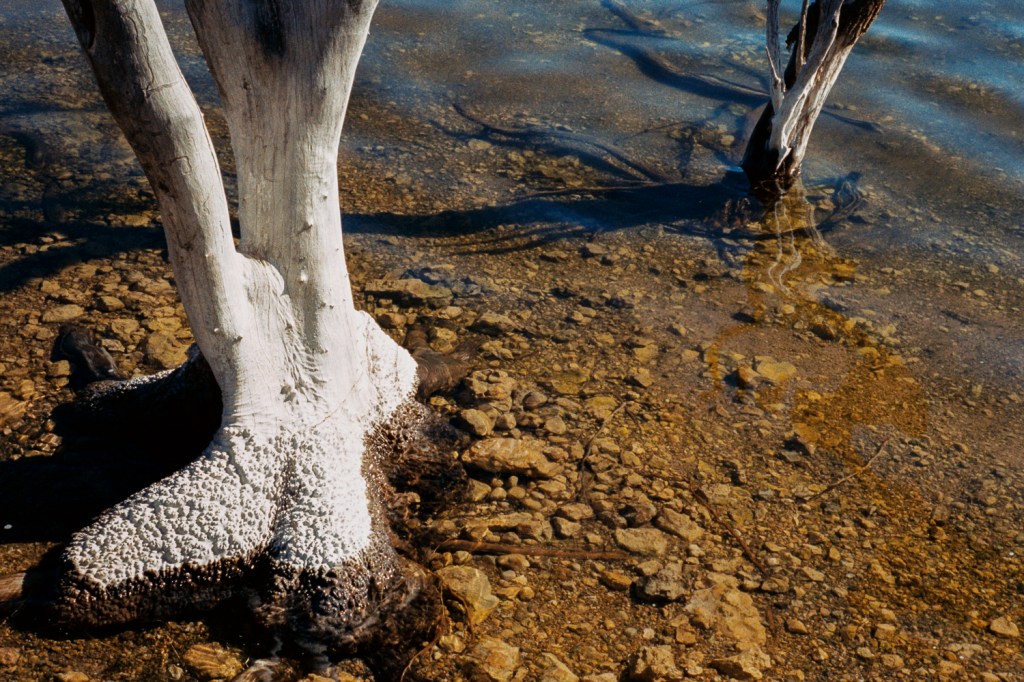
In 2004/5 I visited Stockyard Plain, which is a broad, low-lying area, that is located 15 km southwest of Waikerie:
The two primary reasons for the continual flow of the saline groundwater into the River Murray are the clearance of native plants and drainage from irrigation. The latter, in adding water to salty groundwater aquifers, contributes to the elevation of salinity in the River Murray.
Prior to clearing, the perennial, deep-rooted native vegetation used most of the rainfall, root zone drainage (RZD) was very low (order of 0.1 mm/year) and in equilibrium with delayed recharge at the water table. With post-clearing, the shallow-rooted crops and pastures that replaced the native vegetation used less of the rainfall, and deep drainage below the root zone was greatly increased.

The increased drainage moves (slowly) under gravity and causes a wetting front; when the wetting front reaches the water table, recharge occurs. Additional recharge at the water table below cleared dryland areas generates increased groundwater flux and salt load to the floodplain and river .
Mallee vegetation clearance and its replacement with shallow-rooted dryland farming systems results in enhanced root zone drainage and increased (but delayed) groundwater recharge.
The research suggests that with increased irrigation along the Basin’s rivers salinity impacts will increase over time.

 Nourishing Terrains
Leave a reply to salty landscapes – Our Waters Our Country Cancel reply