
We stayed a night at Salt Creek in the Coorong on our return to Adelaide after spending a few days on the Mornington Peninsula in Melbourne with family. The overnight stay allowed me to do some photography on an early morning poodlewalk around the eroded calcified limestone formations at the Salt Creek outlet and the South Lagoon.
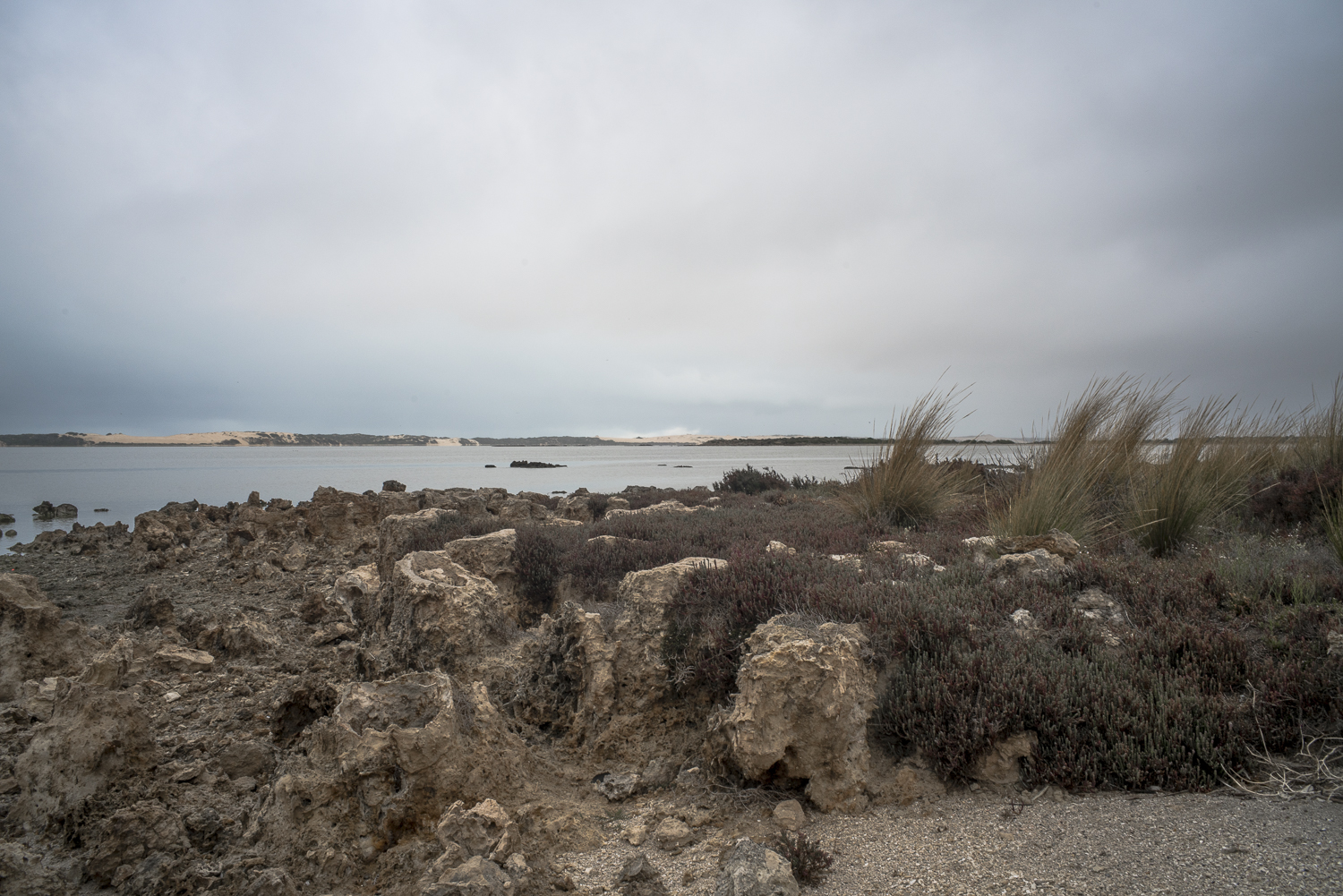
The South Lagoon runs from Parnaka Point to south of Salt Creek and I was guided by this report by the Goyder Institute which had highlighted the decrease in waterbird abundance in the Coorong. It stated that this decrease was been associated with a recent shift from an aquatic plant-dominated to an algal-dominated system.
The algae is preventing crucial aquatic plants, like Ruppia tuberosa, from completing their lifecycle and is interfering with the waterbirds’ ability to feed.

I noticed an abundance and wide distribution of the filamentous algae in Salt Creek and in the South Lagoon near the Salt Creek outlet.
My understanding is that the overabundance of algae plant growth is a symptom of excessive nutrients (phosphorus and nitrogen) in the creek. These nutrients probably come from the runoff from the crop fields and the flows in the South East Drainage network. The algae thrives off the phosphorus released when the herbicides such as glyphosate (in Monsanto’s Roundup) is sprayed on certain soils.

The South East Flows Restoration Project (SEFRP) is designed to direct freshwater from the Blackford Drain into the South Lagoon via the Morella Basin and Salt Creek. Currently the Blackford Drain discharges into the ocean near Kingston.
These increased fresh water flows into the South Lagoon aim to reduce the high salinity levels in the hypersaline South Lagoon that are the result of the reduced Murray River flows into the Coorong.
After breakfast we moved on so that I could explore and scope possible sites around the Long Point area for the Our Waters project. The sites I’d identified were tentatively, the old fishing shacks along the Karoo Road and Dodd Landing Point (for the Maria Massacre)
My interest is the hangings of the aboriginal men by the state given that Australia’s official silence about the frontier conflict and wars is difficult to understand and is probably due to our institutional racism. The common view is that this conflict was what international lawyers used to call private warfare, more akin to banditry and crime arising from personal revenge, as well as trespass, theft and disputes about women, rather than bout land, about ownership and control of the country.
I discovered that there is no public road to the Dodd Landing Point and so public access is going to be difficult. Access by boat is probably the best option.
 Nourishing Terrains
Leave a comment